 Cued
Is it legal to record a Zoom call? Consent rules for client calls
By Harshit Maurya, maker of Cued · Updated 16 October 2026
Usually, yes, if you have the consent the law requires. US federal law and most states need only one person on the call to agree, and that can be you; about 11 states, including California, Florida, Illinois and Pennsylvania, need everyone's consent. When people join from different places, follow the strictest rule, and the simplest way to do that is to ask everyone at the start. This isn't legal advice.
One-party vs all-party consent: what's the difference?
Under one-party consent, you can record a conversation you are part of without asking anyone else. Under all-party consent (often called two-party), everyone in the conversation has to agree first. The US federal wiretap law (18 U.S.C. § 2511) sets the one-party rule as the national minimum, and states can be stricter. That summary comes from the Reporters Committee for Freedom of the Press, whose recording guide is one of the clearest plain-English references.
| Rule | Who must agree | Where (US) |
|---|---|---|
| One-party consent | At least one person on the call (you, if you are in it) | Federal law and most states |
| All-party consent | Everyone on the call | California, Delaware, Florida, Illinois, Maryland, Massachusetts, Michigan, Montana, New Hampshire, Pennsylvania, Washington |
| Mixed rules | Depends on whether it is a phone call or in person | Connecticut and Nevada (all-party for phone calls); Missouri and Oregon (all-party in person); Hawaii and Maine (all-party in private places) |
A video call doesn't fit neatly into "phone" or "in person", which is one more reason not to lean on the gaps. If you ask everyone, the difference stops mattering.
Can I record calls across consent states?
Assume the stricter state's rule applies. The Reporters Committee notes that courts differ on whether the law of the place where the recording is made or where the other person is located applies, and gives the example of a reporter in Virginia (one-party) recording someone in Maryland (all-party) and facing liability under Maryland law. On a Zoom call with clients in several states, you rarely know where everyone is sitting, so ask everyone.
In a one-party state, is it legal to record a Zoom call I'm in?
Under your own state's law, generally yes, because you are a party and you consent. But the other people may be in an all-party state, the meeting host or your employer may have their own rules, and some professions have stricter duties (see below). The one-party rule protects you less than it seems once a call has more than two people in more than one place.
Is a transcript considered a recording?
Treat it as one. Federal wiretap law defines "intercept" as the "aural or other acquisition" of what is said, not only making an audio file. In August 2026 a federal court in California let wiretap claims go forward against Otter.ai, where the plaintiffs say its notetaker transcribed meetings in real time without the consent of everyone in them. That order was on a motion to dismiss, not a finding that Otter did anything wrong, but it shows that live transcription is being argued about under the same consent laws as recording.
So the practical rule is simple: if software is listening to the call and writing it down, get the same consent you would for a recording.
Is it legal to screen record a Zoom meeting without permission from the host?
The law cares about the consent of the people being recorded, not the host's button settings. Zoom, Google Meet and Teams limit who can use their own Record button, and they notify everyone when it is used. Recording with another app skips both of those. Whether that is legal depends on the consent rules above; whether it is acceptable depends on the people on the call. In all-party states, recording people who haven't agreed can be a crime.
UK and EU: tell people and have a reason
In the UK and EU the question is framed as data protection rather than wiretapping. The UK Information Commissioner's Office says people have a right to be informed when you collect their personal data, at the time you collect it: who you are, why you are processing it and on what lawful basis, who it will be shared with, how long you will keep it, and what their rights are. For a recorded client call, that means saying you are recording, why, where it is kept and for how long, ideally in your engagement letter and again at the start of the call.
Extra rules for lawyers and other professionals
Professional duties can be stricter than the law. The New York City Bar Association's Formal Opinion 2025-6 (December 2025) says that lawyers must notify clients and get their consent whenever calls are recorded by an AI system, even though New York is generally a one-party state. It also tells lawyers to check how the AI tool stores, retains and uses the data, and to review transcripts and summaries for accuracy. Accountants, advisers, therapists and others should check their own professional body's guidance.
How to get consent on a client call
- Mention it before the call. Add a line to the invite or your engagement letter: you record calls for your notes, where they are kept and for how long.
- Ask at the start. "Is it OK if I record this so I can listen instead of typing? It stays on my laptop." Wait for each person to answer.
- Get the yes on the recording. The Reporters Committee calls recording the person's spoken consent best practice. If someone joins late, ask them too.
- Stop when asked. If anyone says no, or asks you to stop halfway, stop and take notes by hand.
- Keep only what you need. Delete recordings you no longer need, and share the summary rather than the raw file.
Where an on-device recorder fits
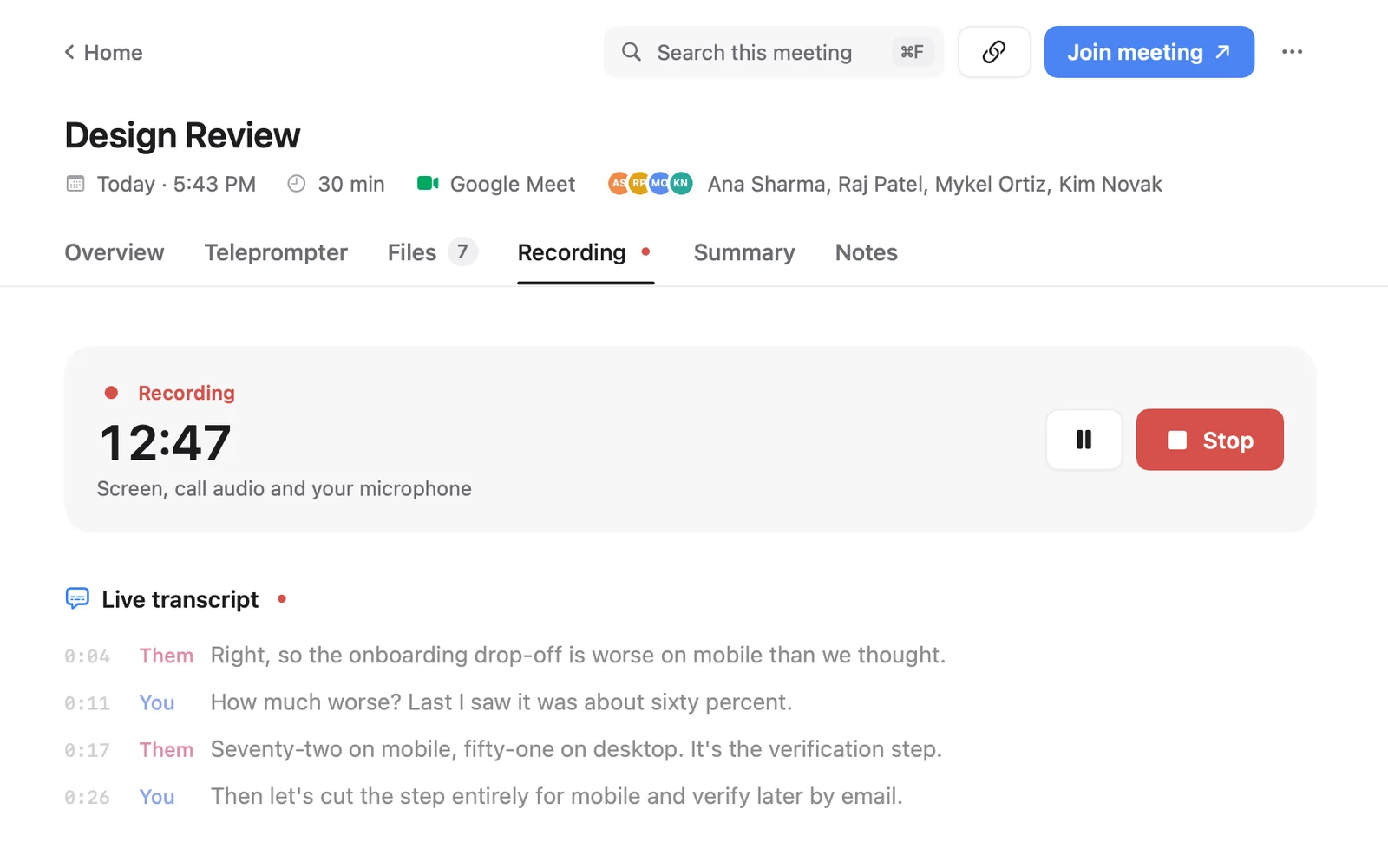
Where the recording goes doesn't change who must consent, but it does change what you can promise a client. A notetaker bot usually sends the call to the vendor's servers; an on-device recorder keeps it on your computer. Cued is one example on a Mac: it records the screen and both sides of the audio through the Mac, with no bot, and transcribes and summarises on the device. Nothing is uploaded. Because no bot joins, no one is notified automatically, so asking for consent is up to you.
Cued needs a Mac with Apple silicon and macOS 15 or later, and is designed for MacBooks with a notch. Cued is a one-time payment, not a subscription: $9 for the first 50 founding members, then $29 with a year of updates.
This isn't legal advice. Laws change and depend on where everyone on the call is, so for anything important ask a lawyer where you work.
Questions
Is it illegal to record a Zoom call without telling people?
In about 11 US states, recording people who haven't agreed can be illegal. In one-party states it is generally legal if you are on the call, but other people may be in all-party states. Asking everyone avoids the problem.
Which states are two-party (all-party) consent states?
California, Delaware, Florida, Illinois, Maryland, Massachusetts, Michigan, Montana, New Hampshire, Pennsylvania and Washington, according to the Reporters Committee for Freedom of the Press. A few others use different rules for phone calls and in-person talks.
Does Zoom's recording notice count as consent?
Zoom's disclaimer lets people consent by staying or leave. The Reporters Committee notes that consent is often presumed when people are warned and keep talking, but recommends getting spoken consent on the recording.
Is a Zoom transcript considered a recording in California?
Treat it as one. Federal law defines interception broadly, and wiretap claims about real-time transcription are being argued in a California federal court. Get the same consent for a transcript as for a recording.
Do I need consent to record a call in the UK?
UK data protection law requires you to tell people when you collect their personal data, why, and how long you keep it. Say you are recording and why at the start of the call.
How much does Cued cost?
Cued is a one-time payment, not a subscription: $9 for the first 50 founding members, then $29 with a year of updates.
Try Cued on your next call. Your script in the notch, your call recorded and summarised on your Mac.
Download for MacSources
- Introduction to the Reporters Recording Guide, Reporters Committee for Freedom of the Press
- 18 U.S. Code § 2510, definitions ("intercept", "contents"), Cornell Legal Information Institute
- In re Otter.ai Privacy Litigation, order granting motion to dismiss in part, N.D. Cal., 13 August 2026
- Core privacy claims against AI note-taking platform survive dismissal, Baird Holm, August 2026
- Right to be informed, UK Information Commissioner's Office
- Formal Opinion 2025-6: ethical issues affecting use of AI to record, transcribe and summarize conversations with clients, New York City Bar
- Customizing the recording consent disclaimer, Zoom Support
- Is it legal to screen record a Zoom meeting without permission from the host? Quora