 Cued
Discovery call questions for designers, consultants and freelancers
By Harshit Maurya, maker of Cued · Updated 16 October 2026
Good discovery call questions find out five things: what the client wants to change and how they'll measure it, the budget, the deadline, who decides, and what they've already tried. Ask a few open questions from each group, then listen more than you talk. The cue card below has 20 short questions you can copy into your notes, or into the MacBook notch with Cued.
What is a discovery call, and why does it matter?
A discovery call is the first proper conversation with a possible client, before you write a proposal. For a freelancer it decides three things: whether to propose at all, what the scope should be, and what to charge. Skip it and you guess at all three.
Design teams run the same kind of conversation as stakeholder interviews. Nielsen Norman Group says they give you context, surface the business goals people care about and build buy-in, and that they help most when done early. Its suggested topics map closely onto a freelancer's discovery call: what success looks like, current challenges, constraints, and solutions tried before and why they worked or failed.
The cue card: 20 discovery call questions
| Group | Question | What you're listening for |
|---|---|---|
| Goals | What made you reach out now? | The trigger: a launch, a complaint, a new boss |
| Goals | Six months after this project, what's different? | The outcome, not the deliverable |
| Goals | How will you know it worked? | A number or signal you can report against |
| Goals | Who is this for? | The customers or users, in their words |
| Budget | What is this problem costing you today? | The size of the problem, before any price |
| Budget | Have you set aside a budget or a range? | Whether money exists yet |
| Budget | How have you paid for work like this before? | Fixed fee, day rate or retainer |
| Budget | If the budget is tight, what matters most to keep? | What you can cut from scope |
| Timeline | Is there a date this must be ready by? What happens then? | A real deadline or a wish |
| Timeline | What happens if it slips by a month? | How urgent it really is |
| Timeline | When do you want to decide? | When to follow up |
| Timeline | Who gives feedback on your side, and how fast? | Whether your schedule is realistic |
| Decision-makers | Who else will read the proposal? | Everyone who needs convincing |
| Decision-makers | Who signs off the final work? | The person who can say no at the end |
| Decision-makers | Who might push back, and why? | Objections you can answer early |
| Decision-makers | How have you chosen freelancers before? | How you'll be compared |
| Past attempts | What have you already tried? | What not to propose again |
| Past attempts | What worked, and what didn't? | Their taste and their limits |
| Past attempts | Have you worked with someone on this before? How did it go? | What went wrong last time |
| Past attempts | What do you never want to repeat? | Red lines for the project |
Frameworks behind the questions: BANT and SPIN
Two sales frameworks sit behind most discovery call advice. You don't need either by name, but they explain why the groups above work.
- BANT stands for Budget, Authority, Need and Timeline. HubSpot's guide to it warns against rushing: earn the right to ask by focusing first on the client's problem, and don't assume it can all be covered on the first call. On budget, it suggests asking about the cost of the problem instead of opening with a figure.
- SPIN comes from Huthwaite International, which developed SPIN Selling from observing more than 35,000 sales calls. It orders questions as Situation, Problem, Implication and Need-Payoff. Huthwaite warns that situation questions should be limited, because buyers get bored or feel interrogated.
- On the cue card, Goals and Past attempts are the Problem and Implication questions. Budget, Decision-makers and Timeline are BANT's Budget, Authority and Timeline. Keep background questions short: look up the company before the call instead.
How to use the questions without reading a script
- Pick eight to ten. Two from each group is plenty. Choose the ones you can't answer from the client's website or brief.
- Shorten each one to a prompt. Write three to six words, not a full sentence: "Cost of doing nothing?", "Who signs off?". A prompt reminds you; a sentence makes you read.
- Order them: problem first, money later. Start with goals and past attempts. Ask about budget once the client has described the problem and what it costs them.
- Ask, then stop talking. Let the silence run. When an answer matters, ask them to tell you more or give an example.
- Skip what they've already answered. Clients often answer three questions in one story. Tick them off in your head and move on.
- Close with a next step. Agree what happens next and when. Ask who else you should talk to, then send a short recap the same day.
How to load the cue card into the notch with Cued
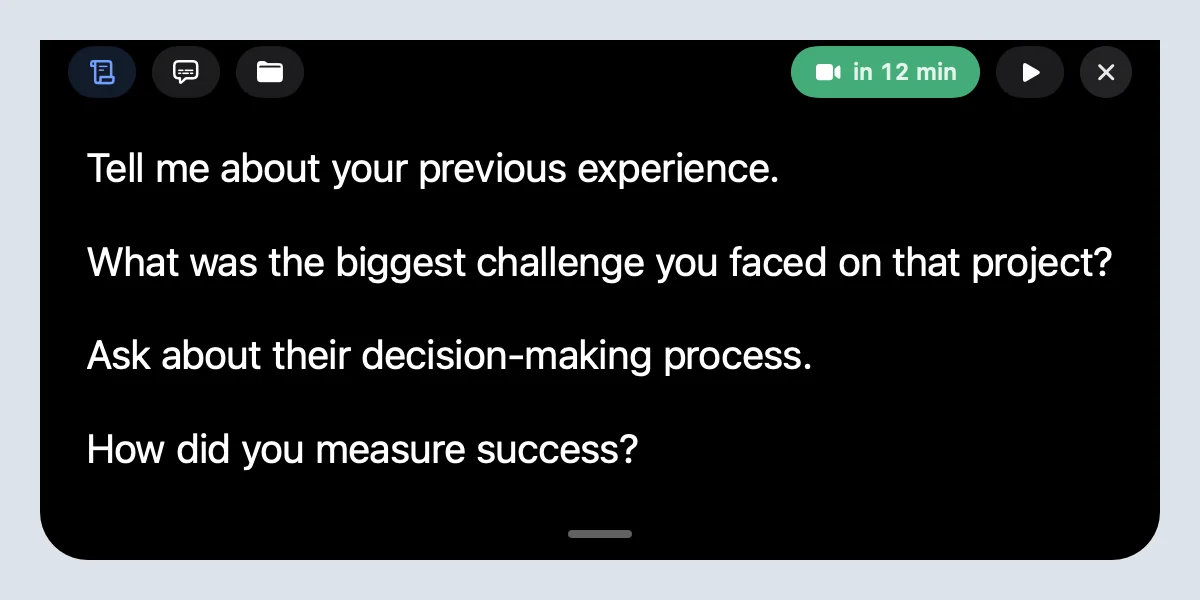
Looking down at a notepad or across at another window is the giveaway that you're reading. Cued puts your prompts in the MacBook notch, right under the camera, so a glance at your notes looks like eye contact.
- Open the meeting in Cued and paste your eight to ten prompts into its Teleprompter tab. A blank line starts a new prompt.
- Thirty minutes before the call, the notch shows the meeting's prompts, its files and a Join button. Keep your proposal, portfolio or rate card there, one click away.
- Press play and the prompts scroll by themselves at Slow, Normal or Fast. Point at the notch and they hold still; use the arrow keys to jump to the next prompt.
- The notch is hidden from screen sharing and screen recordings, so the client never sees your cue card.
- Short on time? Prepare me reads the websites in the invite and writes a research prompt about the people and the company to use with the AI assistant you prefer.
- With the client's consent, Cued also records the call with no bot, transcribes it on your Mac, and writes a summary, action items and a draft follow-up email afterwards.
Cued is a one-time payment, no subscription: $9 for the first 50 founding members, then $29 with a year of updates. Cued needs a Mac with Apple silicon and macOS 15 or later, and is designed for MacBooks with a notch.
Questions
How does a salesperson conduct a discovery call?
Research the company first, then spend the call on open questions about the problem, its cost, the timeline and who decides. Talk less than the client, and finish with an agreed next step. HubSpot's BANT guide warns against trying to cover everything on the first call.
What questions are good to ask when doing customer discovery?
Questions about what happened, not opinions: what they've tried, what it cost, what changed, who was involved. Our cue card groups them into goals, budget, timeline, decision-makers and past attempts.
As a UX designer, what should I ask clients at the first discovery meeting besides goals and vision?
Ask how success will be measured, who the users are, who signs off, what has been tried before and why it failed, and how fast you'll get feedback. Nielsen Norman Group's stakeholder interview topics cover the same ground.
What are the most critical questions in the discovery phase of a consulting engagement?
What outcome the client is paying for, how it will be measured, what doing nothing costs, who decides, and what has already been tried. Those decide the scope and the fee.
Should I ask about budget on the first call?
Yes, but after the problem. Ask what the problem costs them first, then whether they have a budget or a range. A client who won't discuss money at all is useful to know about early.
Can the client see my notes in the notch?
No. Cued's notch is hidden from screen sharing and screen recordings, so it stays on your screen only.
Try Cued on your next call. Your script in the notch, your call recorded and summarised on your Mac.
Download for Mac