 Cued
AI notetakers for lawyers, accountants and financial advisers: what to check first
By Harshit Maurya, maker of Cued · Updated 16 October 2026
Before using an AI notetaker on client calls, check four things: whether client information leaves your control and whether the client agreed, whether you must keep the transcript as a record, what the vendor does with the data, and whether everyone on the call has consented to recording. For lawyers, ABA Formal Opinion 512 and NYC Bar Formal Opinion 2025-6 set out these duties. This isn't legal advice.
What do your confidentiality rules say about AI notetakers?
Each profession has its own rules, but they point the same way: know where client information goes, get the client's agreement when it goes to a third party, and check the AI's output yourself. Here is the general picture from the sources we read on 16 October 2026.
| Who | Rule or guidance | What it asks of you |
|---|---|---|
| US lawyers | ABA Formal Opinion 512 (29 July 2024), on generative AI | Informed client consent before putting confidential information into a self-learning AI tool; boilerplate in an engagement letter is not enough. Investigate the tool's security and policies, and verify its output. |
| Lawyers in New York | NYC Bar Formal Opinion 2025-6 (22 Dec 2025), on AI recording, transcription and summaries | Tell clients and get consent before AI recording, even though New York is a one-party consent state. Understand where the tool stores data, for how long, whether it trains on it, and how to delete. Review transcripts and summaries yourself. |
| US CPAs | AICPA Code, interpretation 1.700.040 (third-party service providers) | Before sharing confidential client information with a service provider, get the client's consent or a contract that keeps it confidential. |
| US tax preparers | Internal Revenue Code section 7216 | Written client consent before disclosing or using tax return information, apart from listed exceptions. It is a criminal provision. |
| Broker-dealers | FINRA 2026 Annual Regulatory Oversight Report | FINRA's rules are technology neutral; generative AI can bring in the rules on supervision, communications and recordkeeping. |
| SEC-registered advisers | Advisers Act rule 204-2 (books and records) | AI notes and transcripts can be records; whether you must keep one depends on what it contains. |
Do you have to keep AI meeting notes as records?
Possibly, and that surprises people who chose an AI notetaker to save time. A Cooley analysis from April 2026 notes that rule 204-2 defines a record to include transcribed information of any type, so an adviser using an AI notetaker is generating records. Whether a particular transcript must be kept depends on its content, and Cooley suggests deciding category by category in advance, warning that keeping everything is not automatically the safe choice. FINRA's 2026 report says generative AI can bring in its recordkeeping rules and suggests storing prompt and output logs.
The NYC Bar opinion makes a related point for lawyers: if your firm's policy is not to keep recordings, disclose the policy and follow it strictly. It also advises reviewing transcripts and summaries soon after the call, because they may be relied on years later.
Questions to ask any AI notetaker vendor
| Question | Why it matters | Cued's answer |
|---|---|---|
| Does a bot join the call? | Clients see it, and some object | No bot; it records through your Mac |
| Where is the audio transcribed and summarised? | Cloud processing sends client words to a third party | On your Mac, with on-device models |
| Where are recordings kept, and for how long? | Your rules may limit where client data lives | In Cued's folder on your Mac, until you delete them |
| Is our data used to train AI models? | The NYC Bar opinion lists this as a question to check | Nothing is uploaded, so there is nothing to train on |
| Can I delete a recording completely? | Clients and policies may require it | Yes: delete only the video, or the recording with its transcript, summary and files |
| Will you notify us of a breach or a subpoena? | ABA Opinion 512 expects lawyers to check this | There is no Cued server holding your calls; your Mac's security is yours to manage |
| Does it feed our compliance archive or CRM? | Regulated firms often must capture records centrally | No. Cued has no compliance archiving and no CRM sync |
| What does it cost? | Per-seat subscriptions add up | A one-time payment, no subscription |
Consent: telling clients you're recording
Recording law and professional rules are separate questions. On the law, the Reporters Committee for Freedom of the Press explains that US federal law needs one party's consent, while about 11 states need everyone's, including California, Florida, Illinois, Maryland, Massachusetts, Pennsylvania and Washington. For calls across state lines, assume the stricter rule applies, and the best practice is to record the other person's spoken consent. On professional rules, the NYC Bar opinion says lawyers should tell clients before AI recording even where one-party consent would be legal.
- Put it in the engagement letter. The NYC Bar opinion notes that engagement letters can address recording. Say what you record, why, where it is kept and when it is deleted.
- Say it at the start of each call. "I record our calls so I can listen instead of typing. It stays on my laptop. Is that OK?" Their yes is then on the recording.
- Stop if they say no. In Cued, ⌥R stops the recording.
- Check the summary before relying on it. Both opinions expect you to review AI output yourself. Correct names, figures and dates.
- Keep or delete by policy. Keep what your rules require, in the place they require. Delete the rest.
Where Cued fits, and where it doesn't
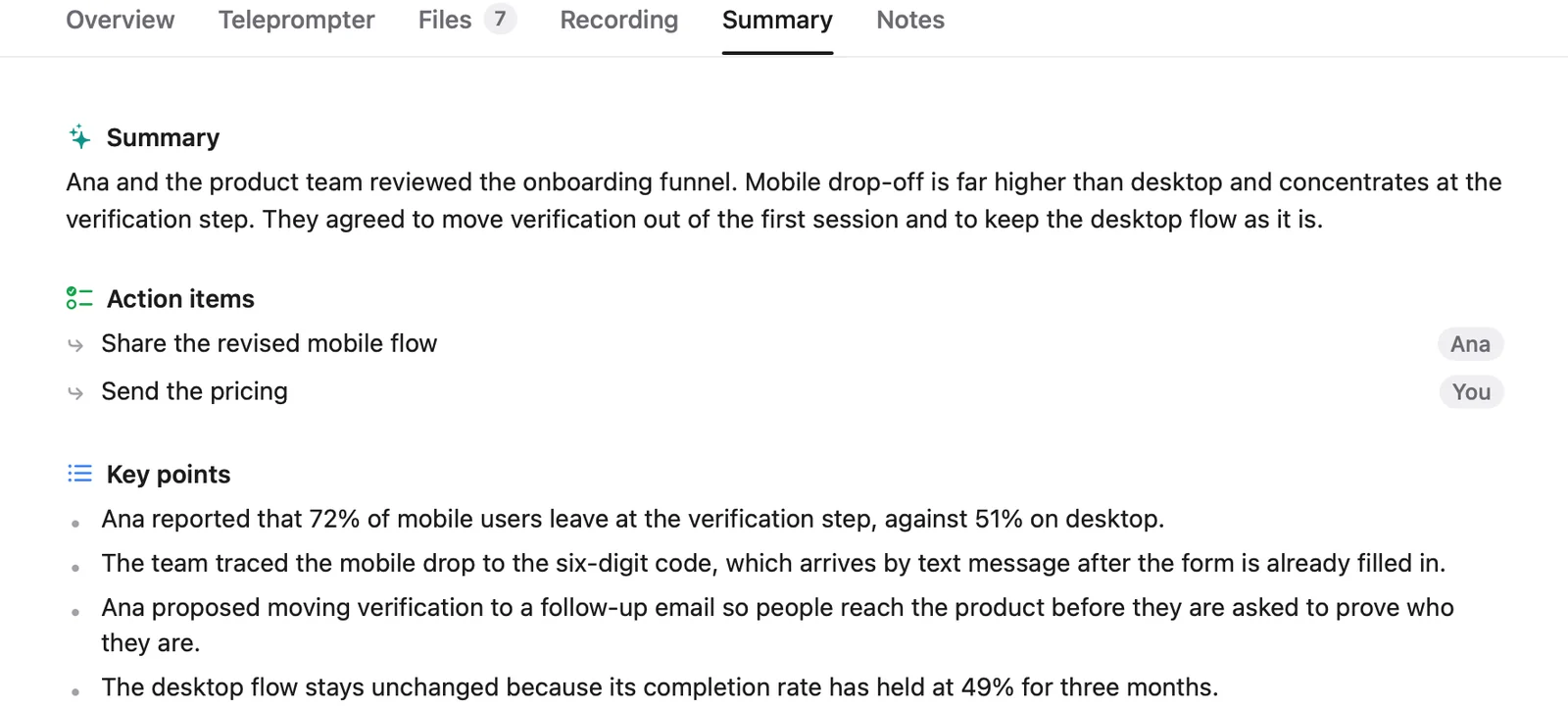
Cued suits a solo lawyer, accountant or adviser whose rules allow recording client calls with consent, and who wants the notes to stay on their own Mac. It records Zoom, Google Meet, Teams, FaceTime, Webex and Slack calls through the Mac with no bot, transcribes them live on the device, and writes a summary with action items and a draft follow-up email that you review and send yourself. Nothing is uploaded. Since no bot joins, nobody is notified automatically, so telling the client is your job.
What Cued is not: it is not a compliance product. It has no compliance archiving, no CRM sync, no team workspace, and no HIPAA, SOC 2 or other certification. Transcripts are in English and are good, not perfect. If your firm must capture every client communication into a supervised archive, Cued does not do that for you. Cued is a one-time payment, no subscription: $9 for the first 50 founding members, then $29 with a year of updates. Cued needs a Mac with Apple silicon and macOS 15 or later, and is designed for MacBooks with a notch.
This isn't legal advice. Check the rules that apply to you with your regulator, your professional body or a lawyer.
Questions
Is it safe for lawyers to use AI notetakers on client calls?
It can be, with the client's informed consent and a tool you have checked. ABA Formal Opinion 512 asks for informed consent before confidential information goes into a self-learning AI tool, and the NYC Bar's 2025-6 opinion asks lawyers to tell clients before AI recording. This isn't legal advice.
Can financial advisers use AI note takers in client meetings?
Many do, but the notes can count as records. A Cooley analysis says AI notes are records under the SEC's rule 204-2, and FINRA says its recordkeeping rules can apply to generative AI. Decide what you keep before you start.
Has Cued passed compliance at a fund or an RIA?
No. Cued makes no compliance claims and has no certification, compliance archiving or CRM sync. It keeps recordings, transcripts and summaries on your Mac.
If the notetaker runs on my Mac, do I still need client consent?
Yes. On-device processing keeps the data with you, but recording laws and professional rules still apply. Tell the client and get their consent.
Can recording a call put attorney–client privilege at risk?
The NYC Bar opinion warns that kept recordings carry risks, such as preserving offhand remarks an opponent could use, and that clients recording with their own tools can risk privilege. Talk to your ethics counsel.
How much does Cued cost?
Cued is a one-time payment, no subscription: $9 for the first 50 founding members, then $29 with a year of updates.
Try Cued on your next call. Your script in the notch, your call recorded and summarised on your Mac.
Download for MacSources
- NYC Bar Formal Opinion 2025-6: AI to record, transcribe and summarise client conversations (22 Dec 2025)
- ABA issues formal ethics opinion on lawyers' use of generative AI (Formal Opinion 512), Frankfurt Kurnit
- Working with third-party experts (AICPA ET 1.700.040), Journal of Accountancy, Nov 2022
- Section 7216 frequently asked questions, IRS
- 2026 FINRA Annual Regulatory Oversight Report: GenAI
- AI notetakers and the books and records rule, Cooley (TheFundLawyer), Apr 2026
- Introduction to the Reporter's Recording Guide, RCFP